
Let’s start by removing the pressure.
Many people hear “AI agents” and immediately think it’s too advanced for them to learn. The term sounds technical, futuristic, and intimidating. But the truth is much simpler.
AI agents are not a mysterious new class of technology that requires a PhD. At a very practical level, an AI agent is software that can take responsibility for a task and see it through from start to finish.
Most traditional software is reactive. You click a button, it performs a single action, and it stops. AI agents are different. They are designed to behave more like a capable assistant than a static tool.
An AI agent can understand a goal, decide what steps are needed, take actions using tools, and adjust based on results.
A helpful way to think about an AI agent is as a digital worker. You don’t micromanage every click. You explain the outcome you want, and the agent figures out the process.
This shift from “tell me exactly what to do” to “here’s the goal, handle it” is what makes AI agents powerful. At the same time, the concept itself is grounded, logical, and very practical.
How an AI Agent Thinks, Decides, and Acts #

At the heart of every AI agent is a simple loop.
First, the agent observes. This might be an incoming message, a system event, user behavior, or new data becoming available. Next, the agent thinks. It analyzes context, goals, memory, and instructions using an AI model. Finally, the agent acts. That action could be sending a message, calling a tool, updating a record, or deciding to wait.
What makes this loop important is that it doesn’t end after one action. The agent checks the result of what it did, updates its understanding, and continues the loop. This is why AI agents feel proactive instead of reactive. They are not just responding once, they are managing an outcome over time.
This same loop applies whether the agent is replying to a customer, qualifying a lead, or monitoring a system in the background.
What Actually Makes Up an AI Agent #
To really understand AI agents, it helps to look at what they are built from.
At the core is an LLM (Large Language Model) such as GPT or DeepSeek. This is the reasoning engine that allows the agent to understand language, reason through problems, and generate responses.
On top of that sits prompting, which acts like instructions or a role description. Prompting defines what the agent is responsible for, how it should behave, and what it should prioritize.
Agents also rely heavily on memory. Without memory, every interaction would start from zero. Memory allows agents to remember previous conversations, user preferences, product details, or internal processes.
To handle large amounts of information efficiently, many agents use vector storage. Text, documents, or conversations are converted into numerical vectors so they can be searched semantically rather than by keywords. This allows an agent to find relevant information even when something is phrased differently.
Common vector databases include Pinecone, Weaviate, and FAISS. These systems are what allow agents to recall information quickly and reason over large knowledge bases.
Finally, agents use tools. Tools are what allow an AI agent to take real action. A tool might be a CRM, an email system, a calendar, a database, or an API. The agent decides when to use these tools and how to use them to achieve its goal.
Together, these components allow an AI agent to observe, think, and act in a way that feels much closer to a human assistant than traditional software.
How AI Agents Are Different From Chatbots and Automation #
AI agents are often confused with chatbots or automation tools, so it’s important to clarify the difference.
A chatbot responds when you message it.
Automation follows strict rules that someone hard-coded in advance.
An AI agent can decide what to do next.
That decision-making layer is the key difference.
If a customer sends a message, a chatbot replies with a preset answer. An automation triggers a predefined rule. An AI agent checks context, history, intent, and timing before responding.
Because of this, AI agents can handle situations that don’t fit perfectly into predefined paths. This flexibility is why they are being adopted so quickly across real businesses.
How AI Agents Use Memory, Vectors, and RAG #
One reason AI agents feel intelligent is how they access and use information.
Most modern agents use RAG, or Retrieval-Augmented Generation. RAG allows an agent to retrieve relevant information from external sources and then generate an accurate response based on that information.
In practice, documents, FAQs, manuals, or past conversations are converted into vectors and stored in a vector database. When a user asks a question, the agent converts that question into a vector, searches for similar vectors, retrieves the most relevant information, and feeds it into the language model before generating a reply.
For example, imagine a support agent for a heat pump company. Product manuals, FAQs, and past support chats are embedded into a vector database. When a customer asks, “How much power does this unit use?”, the agent retrieves the relevant documentation and answers accurately.
This is how AI agents move beyond generic responses and become genuinely useful in real businesses.
How AI Agents Show Up in Everyday Life #
AI agents are already part of everyday digital experiences, even if they aren’t labeled as such.
You see them in customer support systems that resolve issues without human help, sales tools that qualify leads and follow up automatically, marketing platforms that adapt messaging based on behavior, and internal tools that monitor data and alert teams when something changes.
All of these systems follow the same loop: observe what’s happening, decide what matters, act, and then learn from the outcome.
Once you understand this loop, AI agents stop feeling abstract and start feeling very concrete.
How AI Agents Work in Practice Inside Pulse #
In Pulse, AI agents are used to run real conversations across SMS and email, not just send messages.
A Pulse AI agent can read and understand incoming messages, decide whether to reply immediately or wait, personalize responses using past interactions, automatically follow up if someone goes quiet, and escalate to a human when needed.
Instead of teams manually managing every conversation, the agent handles the flow. This reduces dropped leads, improves response times, and keeps communication consistent without extra effort.
If you want to see how AI agents operate in real customer-facing scenarios, Pulse is a practical example of how this technology already delivers value today.
Using Multiple AI Agents Together Without Making Things Messy #
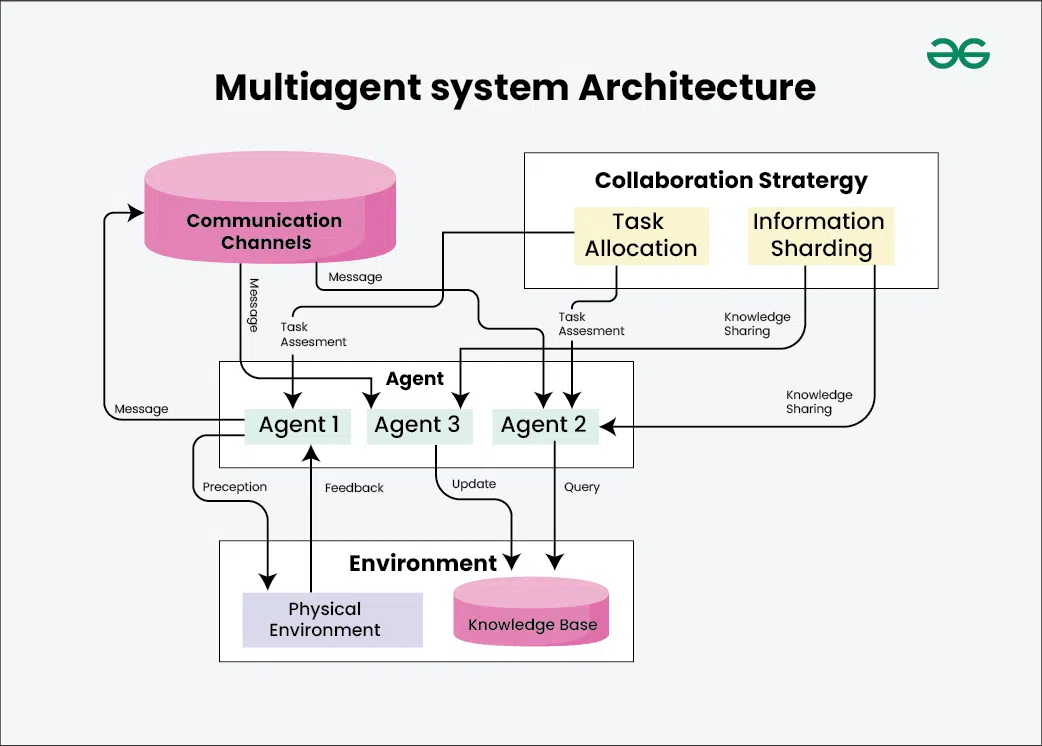
Trying to make one AI agent do everything usually leads to worse results. That’s why modern systems rely on multiple specialized agents, each with a clear role.
One agent might gather information. Another analyzes and makes decisions. Another communicates with users. Another monitors outcomes and edge cases.
These agents don’t constantly talk over each other. They coordinate through events and signals. This mirrors how strong human teams operate and scales far better than a single “super agent” trying to do everything.
This same structure is used in production-grade AI systems and conversational platforms like Pulse, where reliability and clarity matter.
Tools You Can Use to Build AI Agents Today #
You don’t need to build AI agents from scratch.
There are beginner-friendly platforms like Relevance.ai and Make.com, as well as more advanced tools like n8n for complex workflows. Hybrid setups are common, where one platform handles reasoning and memory while another handles integrations and automation.
Frameworks such as LangChain, AutoGPT, CrewAI, and MetaGPT are often used behind the scenes to manage planning, memory, and coordination.
It’s also important to be realistic. AI agents are not perfect and not ideal for every use case. Many businesses still prefer deterministic workflows for critical operations. Agents shine best in conversational experiences, internal tools, and nurturing flows where flexibility adds value.
Where AI Agents Are Going Next #
In the near future, AI agents will increasingly run in the background of existing software.
Instead of logging into multiple tools, people will rely on agents to monitor systems, handle routine decisions, and surface only what truly needs attention. Agents will be embedded directly into CRMs, inboxes, and ecommerce platforms. They will coordinate across tools rather than replace them and hand off to humans when confidence is low or stakes are high.
This is not about full autonomy everywhere. It’s about reducing friction and manual work where it makes sense.
Why AI Agents Matter and Why Learning About Them Is Worth It #
AI agents matter because they change how work scales.
They don’t just save time on individual tasks. They reduce delays, prevent mistakes, and allow processes to run consistently without constant oversight.
Understanding AI agents helps you design smarter workflows, choose better software, avoid brittle automation, and stay relevant as tools evolve. You don’t need to build agents yourself to benefit from them. You just need to understand how they work and where they add value.
Platforms like Pulse prove that AI agents aren’t theoretical. They’re already running conversations, managing follow-ups, and driving real results.
Unlock AI-powered SMS and email with Pulse. Start building two-way messaging journeys in minutes, connect your number, and let AI agents handle the heavy lifting. Start free with Pulse today.
Unlock AI-Powered SMS & Email With Pulse #
Start building 2-way SMS, email and WhatsApp-ready journeys in minutes. No complex setup, no long-term contracts – just connect your number and let Pulse’s AI do the heavy lifting.


